This should be me up to date for now!

Laura Shepherd-Robinson, The Art of a Lie: One of the shortlist for the CWA Historical Dagger, this is set in Georgian London and concerns a recently widowed confectioner and Henry Fielding’s investigation into her husband’s murder. When a handsome gentleman comes into her shop and introduces her to the concept of iced cream, her life changes radically – he offers to help her reclaim money she did not even know her husband had, which will help her save her threatened business. And I don’t know what else I can say without giving away too much of this very clever switchback of a plot that really had me on the edge of my seat, wondering what would come crashing to the ground first. There are a few slightly anachronistic phrases which made me stop, but otherwise this is an excellent read.

Fflur Dafydd, The Library Suicides: Quite an
odd but enjoyable book set mostly in what I suspect is intended to be the
National Library of Wales, in an alternative future where paper is banned as
something that carries germs after the great pandemic. A fire is said to have
destroyed most of the historical books in the library, too. Ana and Nan,
identical twins, work in the library but the focus of their life is to take
revenge on a poet and critic, Eben, whose harsh reviews (on behalf of the
Smotherhood) caused their mother, a very successful writer, to commit suicide.
As part of their plan, they trick a new security guard, Dan, into helping them,
which he does in part by hacking into the security camera system to play old
footage instead of what is actually happening. But this illusion is only one of
many: nothing and no one is quite what it seems in this clever satire on all
kinds of attitudes in society today.

Cecilia Peartree, The Way to Icy Death: A
long-standing character in this delightful mystery series lies dead in the ice,
and another familiar person is suspected. This is a classic whodunnit set in
the gloriously eccentric Pitkirtly community with all its weird characters –
lovely comfortable reading with lots of laughs.

Helen Harper, Gifted Thief: An alternative
reality fantasy set in Scotland. Our narrator is the last representative of the
hated Clan Adair, one of the ruling fae Clans, needed to help in a desperate
plan to save magic from vanishing. However, she has grown up away from fae
culture in a gang of professional thieves in Aberdeen, and though she has not
been granted her fae powers she has a few skills that might come in handy –
that and a genie trapped in a magic letter opener.
This author has a few complete series set in worlds where magic is a given and
strong women prevail against the odds – I like her sense of humour and I’m
looking forward to reading more.

Jean Gill, With Raven Wine: This may seem an
odd title, but raven wine is a poetic kenning for ‘blood’ and there is
certainly a good deal of it in this, the fourth in Jean Gill’s Viking quartet.
For me, in this book the parallel stories in Orkney and the Mediterranean were
woven together particularly effectively and of course came together at the end.
These books are tremendously well researched and again I thought that in this
one the research and the story sat very comfortably together. A favourite piece
was the professional comparison of Viking and Constantinopolitan armour about
halfway through, which was beautifully done – in fact, the whole Constantinople
section, with the Orcadians suffering severe culture shock, was fascinating.
And the climax of the book, the last few chapters, were gripping and
emotionally charged, and provided a very satisfactory, if sorrowful, ending to
the whole quartet.
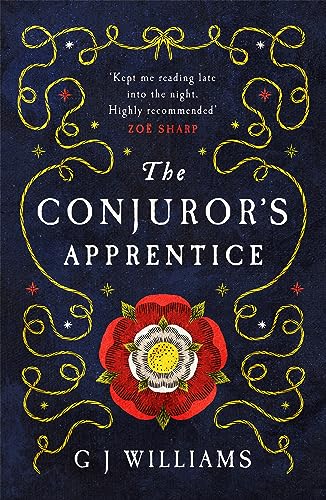
G.J. Williams, The Conjuror’s Apprentice:
Dr. John Dee is the conjuror here, entertainingly portrayed and seen through
the eyes of his Welsh apprentice, Margaretta, who can read people’s emotions.
They are called upon to investigate the murder of a boy whose body was found in
the Thames, and whose secrets may incriminate his employer, Lord Cecil. The
characters leap off the page beautifully, real history is woven in without a
bump, and the pace is cracking. I look forward to the next one.

Aline Templeton, The Trumpet shall Sound:
The beautiful setting of Ramillies, a large private house now used as a music
venue, is the scene for quarrels and jealousies over a declining music
festival. Not perhaps the most convincing of Templeton’s endings, for me, but I
still enjoyed her portrayal of breaking and broken relationships as usual.

Veronica Heley, Murder in the Garden, Murder by Committee, and Murder on a Bicycle: one of my favourite
mostly cosy series and I’m delighted to see there are more, even if sometimes
Ellie, the heroine, needs to be told exactly what to do with her horrible
daughter.

Maureen Myant, The Confession: Though I knew this was the start
of a series, it felt as if it could well be a standalone as for a while I
wondered if the main police character would actually make it through the book.
It’s written partly from his point of view and partly from the point of view of
a woman with whom he unwisely becomes involved, the estranged sister of a
suicide victim who has left a confession to five murders. The trouble is that only
one of the murders appears to have happened, and the perpetrator of that seems
very safely convicted. Then, of course, the murders do start. A lovely twisty
plot, even if some of the characters need a good talking to.
And where am I? One and a half chapters in to The Raven in Silver (Orkneyinga 6), nowhere near as far ahead as I should be or wanted to be, but at least it has started.

No comments:
Post a Comment