Clearly I was a little ratty in October - sorry! Just let the cross ones wash over you ...

Patricia Finney,
The Duke of York: a good little novelette (I think? Shorter than a
novella) concerning an attack on the infant Duke of York and the work of Sir
Robert and Lady Carey to subvert it. As usual these books have sound historical
detail, lots of action, and a few laughs, and the characters are strong even in
as short a time as this. However, I hate the cover so much I nearly didn't include it here!

G.J. Williams, The Wolf's Shadow – I’m sorry – ‘Sir Cecil’? For William Cecil? Where are
you from? And Mildred would be Lady Cecil, not Lady Mildred Cecil. This is very
disappointing, as I’d enjoyed the first in the series very much. And in it
Cecil was Lord Cecil, so I’m not sure where this has come from. And then the
coachman just casually refers to him as ‘Cecil’! Good grief. Margaretta calls
him ‘sir’ rather than ‘my lord’. And Christopher Careye would hardly pick at
the spelling of his surname when spellings were far from set. And Westminster
Cathedral, rather than Abbey? Two different places, and here different in the
sense that one existed and the other did not. There are other strange uses of
words, too, like ‘you want to ingratiate the rich’ rather than ‘ingratiate yourself
with the rich’. I’m very disappointed. I had enjoyed the first one so much, but
though the plot is interesting enough – son of ‘Sir Cecil’ kidnapped from
university by a bunch of wandering players who may or may not have a connexion
with the Seymours of Wolf Hall – the performance this time is not so good.
Margaretta’s ‘second sight’ insights feel shallow, a bit like Deanna Troy in
Star Trek. ‘Captain, I sense hostility!’ A sad come-down. I have the third one, so we'll see how that goes. Lovely covers, though.
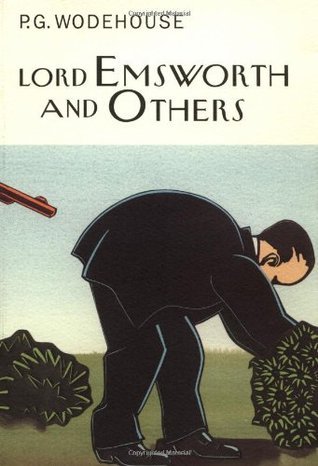
P.G. Wodehouse, Lord Emsworth and Others: A nice one to have to
hand for a quick short story, whether of the unfortunate Lord Emsworth or the
perpetually broke Ukridge with his endless schemes.

Ian McFatridge, The Fold in the Map: A few oddities here, like
the non-capitalisation of Amazon or Google, and maybe a little bit too much
description of the main character’s life and background. There are huge chunks
which would have been better as conversation rather than reported speech, and
there are plenty of grammatical errors, missing capitals (lots!) and question
marks (struggled to find more than two or three), head switching and unexpected
American spellings. Nevertheless I was fascinated by the idea of a ‘ghost’
district of Edinburgh that he sees from the train and that doesn’t appear on
Google Earth (no capitals). Then I became a bit lost in layers of reported
conversations and descriptions and meetings in the lives of the main
characters, an economist, a local minister, a ‘hit man’ for the church and his
wife, which moved from third to first person and back and into which random
characters and theories made their way. Each time a character is introduced
there’s a thick wadding of back story for them. There’s also lots of backstory
to do with a couple of entities that have been given Zoroastrian names –
they’re quite interesting in the different ways they interact with the human
race, but there are too many different metaphors going on all at once. One of
them changes from Ahura to Arusha (which as far as I know is a town in
Tanzania) towards the end. One thread of the plot is the local church’s fight
not to be closed under the current Presbytery Plan, a threat that many Church
of Scotland people will recognise at the moment, though I wasn’t sure that a
very brief sermon on the mental state of John Knox was going to help them much.
I also didn’t find at all convincing the relationship between the two main
characters, regardless of Alec’s unpicking of it afterwards (in which he does
not come across as empathetic, even though he is described as such). The book
began to become a little more interesting around halfway through, when the
minister explains what she thinks she is doing and why, but this culminates in
an odd violent episode which sees our two main characters hiding in a coach loo
when they could probably just have stayed low down – not my idea of fun. The
book sort of kept me reading to the end, but oh, boy, the grammatical errors!

Andrew Garve, The Galloway Case: An older book and here, I think,
in an American reprint with American spelling. The hero falls in love with a
young woman who, it turns out, is the daughter of a convicted murderer,
novelist who is supposed to have killed someone before they could accuse him of
plagiarism. The whole case seems open and shut but the daughter refuses to
believe it and the hero, a journalist, decides to investigate. I very much
enjoyed the investigation with its apparent dead ends, but the final sequence
in a Welsh ‘goldmine’ was a bit unconvincing, I thought – and I’ve no intention
of exploring a Welsh goldmine to find out!

Aline Templeton, the DI Marjory Fleming series. Watch out for changes in titles here! I saw this as Death in Galloway - check on Fantastic Fiction if it's not clear. Once again I have flung
myself into a Templeton series and loved it, though stupidly it took me to Book
Three to realise how it was linked with the Strang series. These are set in the
south-west of Scotland, along the coast, and the setting comes across well.
Once again, Templeton brings a strong cast of characters including some
seriously horrible people, though come-uppances are generally well served. The
only thing about this series was that I found I couldn’t read more than the
first quarter of the first one. It’s set at the time of the foot and mouth
crisis. I just could not. And yet I’m sure it’s excellent. I’m reading them so
quickly that it seems faintly redundant to review them separately, particularly
as I enjoyed them all equally, and (saving the first one) particularly like
Marjory’s grounding in farm life as her husband is a farmer. However, I still don't like Cat!

Vaseem Khan, City of Destruction: Archie-related traumas in this book
but not so much Archie, as Persis attempts to investigate a young would-be
assassin she herself has shot dead, and the murder of a Polish man made to look
like self-immolation. Persis is discovering more support than she thought she
had in Malabar House, but she’s still wonderfully spiky and independent which
of course continues to get her into trouble.

Andrew James Greig, The Graveyard Bell: I got this one because it
matched a category for a book challenge I'm in, then realised that I hadn't
read the second in the series, and this is the third. Still, I enjoyed the
first one, so I pushed on. It’s a good read, with a series of odd deaths around
Mull – a photographer falling off a cliff, a fisherman disappearing after
reaching land, and a diver caught in a vicious creel-trap. There are plenty of
unanswered questions (though one might be why the Tobermory sergeant expects a
report from the coroner, unless Mull has its own little coroner). Irish
wolfhounds and Scottish deerhounds – not aware of an Irish deerhound, but there
we are, could be my ignorance. Some of the questions remain partly unanswered
as the book ends, but it’s still fairly satisfying, and the characters are
interesting – very flawed, but likeable on the whole.

Christopher St. John Sprigg, Crime in Kensington: Though I enjoy
a Golden Age crime (from the time when the nearest aerodromes to London were
Lympne, Croydon and Heston), I found this hard to get in to to start with.
Guilty myself of having characters with odd names, I found the ones in this
residential hotel to be particularly ridiculous when coupled with their
behaviour. For some reason I battled past this eventually and managed to pick
the plot out of it and it turned out to be very good, if still a little over
mannered. I spotted the killer about two thirds of the way through, but the
rest of the yarn still kept me interested.
